Mass conservation
This page derives the discrete conservation contract that holds end-to-end across the AtmosTransport pipeline (preprocessor → binary → runtime → snapshot output) and quantifies the floating-point tolerances at which it holds.
The contract
For every cell c and every CFL-safe advection sub-step:
where F^n_f is the per-substep mass-amount through face f (units: kg per substep, the binary's flux_kind = :substep_mass_amount) and σ_{c,f} ∈ {+1, -1} is the inflow / outflow sign convention for face f at cell c. The same identity holds for every tracer mass μ^n_{c, t}:
with Φ^n_{f, t} the tracer-mass flux through face f. Because m and the tracer-mass slice live on the same staggering and use the same F, Φ triple-pairing, the mixing ratio χ = μ / m of a passive tracer that starts uniform stays uniform exactly under advection — modulo floating-point.
Telescoping divergence — why advection conserves total mass
For a closed periodic domain (lat-lon with periodic longitude) summing the update over all cells gives:
Each interior face appears in the sum twice — once with +F (the cell on the inflow side) and once with −F (the cell on the outflow side) — so the double-sum collapses to boundary fluxes only:
For a closed sphere there is no boundary, so the right-hand side identically vanishes mathematically — and to floating-point in the implementation, provided both cells use the same face flux at the same update stage. Writing each panel's update in flux form is insufficient if neighboring panels reconstruct different tracer fluxes. The structured X / Y / Z kernels in src/Operators/Advection/structured_kernels.jl use shared face values. The telescoping argument does NOT hold for schemes written in advective form (e.g. χ ∂_t = -u ∂_x χ), which is why every advection scheme in this repository is flux-form.
The same telescoping argument extends to:
Cubed-sphere Lin–Rood via shared final panel-edge tracer fluxes (
src/Operators/Advection/LinRoodSeams.jl) and mirrored air-mass fluxes. The q-space Lin–Rood path requires CFL-safe inputs: its existing cell-local emergency flux scaling breaks conservation when activated.Cubed-sphere Upwind, Slopes, and PPM via one cached physical seam transfer applied to both neighbors in the same directional group (
src/Operators/Advection/CubedSphereSeams.jl). This also pairs rotated X/Y contacts. Halo exchange alone is insufficient; see Panel-edge halo treatment (cubed sphere).The reduced-Gaussian grid via the LCM-based ring-boundary face segmentation in
_boundary_counts(nlon_per_ring)insrc/Grids/ReducedGaussianMesh.jl. Each ring-pair boundary is split intolcm(nlon[j], nlon[j+1])segments so the outflow from ringjexactly equals the inflow to ringj+1.
Vertical closure
The discrete continuity equation for the vertical mass flux cm is:
with the surface boundary cm at k = N_z + 1 pinned to zero (no mass flux through the ground). All three production preprocessing paths produce cm via the same diagnostic:
LL spectral preprocessor. Runs FFT-based Poisson balance over the periodic-longitude grid, then calls
recompute_cm_from_dm_target!to diagnosecmfrom the explicit(am, bm, dm)field.RG spectral preprocessor. Runs ring-aware Poisson balance via the compressed Laplacian, then calls the same
recompute_cm_from_dm_target!diagnostic.GEOS native CS preprocessor. Column-balances horizontal mass fluxes against the raw next-hour dry endpoint (
balance_cs_column_mass_fluxes!), then callsdiagnose_cs_cm!(the cubed-sphere analogue ofrecompute_cm_from_dm_target!).
In every case the binary lands with a cm field that closes the explicit-dm continuity equation to floating-point tolerance — the write-time replay gate then verifies it before the binary file is committed to disk.
The production GEOS-CS path does not use the separate FV3-style pressure-fixer cm diagnostic; it closes against the raw dry endpoint described above.
Replay-gate tolerance
Conservation in floating-point is verified per-window via:
replay_tolerance(FT) is defined in src/MetDrivers/ReplayContinuity.jl:
| FT | τ(FT) |
|---|---|
Float64 | 1e-10 |
Float32 | 1e-4 |
The Float32 tolerance reflects the noise floor of single-precision arithmetic at production resolutions (Float32's 23-bit mantissa, giving ~7 decimal digits of precision per operation, accumulates to roughly 1e-5 per substep on a 720×361 grid; the per-window gate is relaxed to 1e-4 to absorb the per-window accumulation).
These replay gates check carrier-air continuity. They do not bound tracer drift or establish consistency of reconstructed tracer fluxes at panel seams; tracer conservation needs its own tests.
The gate fires twice in the lifecycle of a binary:
Write-time (on by default, in the preprocessor). A binary that fails is rejected at write time — the preprocessor errors out rather than producing a known-bad file.
ATMOSTR_NO_WRITE_REPLAY_CHECK=1is an explicit diagnostic escape hatch; do not use it for production binaries.Load-time (opt-in, in the runtime). Set
ATMOSTR_REPLAY_CHECK=1in the environment (no TOML key today; the load-time gate is a driver kwarg or env-var setting). Off by default because it doubles binary load time; recommended for any new binary configuration before a long production simulation.
Implicit diffusion and roundoff
The precomputed cubed-sphere Dkg path solves backward Euler directly for tracer mass. For exchange rate D[k] between layers k and k+1, define u[k] = dt*D[k]/m[k] and d[k] = dt*D[k]/m[k+1]. The mass-space matrix has diagonal 1 + u[k] + d[k-1], lower diagonal -u[k-1], and upper diagonal -d[k]. Its columns sum to one: a closed diffusion column conserves mass.
Ordinary Float32 Thomas elimination in VMR space can lose that cancellation through coefficient rounding and mass/VMR conversion. The state-mass entry point instead uses two column-conservative bidiagonal factors. Their inverses are directed retention/transfer passes. Starting with v[0] = 0, their ratios are
The downward pass retains fraction 1/(1+r[k]); the upward pass retains 1/(1+v[k-1]). Each passes the complementary mass to the adjacent layer. This is a factorization of the same backward-Euler equation, not a correction or rescaling of the tracer total. Factors are shared across all tracers.
The implementation computes the smaller partition directly, because subtracting a rounded retention from one can erase a weak exchange into an empty layer. Compensated incoming sums reduce loss of small layer contributions in stiff columns. A removable constant background is chosen from the concentration range's endpoint closest to zero; profiles spanning zero use zero. Layers with no exchange retain their input values exactly. These operations need no additional persistent workspace and use Float32 arithmetic on Float32 states.
The adjoint reverses the two passes with the same ratios. Tests cover signed and positive tracers, weak transfers down to dt*D/m = 1e-14, stiff columns, zero exchange, and constant total-mass gradients. The public array-level VMR solver and other diffusion geometries retain their existing Thomas paths. The conservation statement assumes positive carrier masses and closed column boundaries; the existing zero-carrier sink convention is preserved separately. Floating-point storage still introduces roundoff, so conservation of the mathematical operator is not a promise of identical stored totals in every run.
On one C90 L66, 24-hour V100 PPM workload after paired advection seams, this diffusion path reduces the maximum final Float32 relative tracer-total drift from 8.17e-7 to 3.14e-7. All six final Float64 compensated totals match initialization; their maximum hourly relative drift is 1.98e-16. The exploratory Float32 target 1e-7 is not met. All six final Float32 column-mean fields are closer to the Float64 result. The initial conservative solve costs 38.635 s median for the 32-tracer day; distributing CUDA tracer solves across threads reduces this to 29.543 s with identical output and no new persistent workspace. The earlier VMR solve with paired advection seams takes 34.574 s.
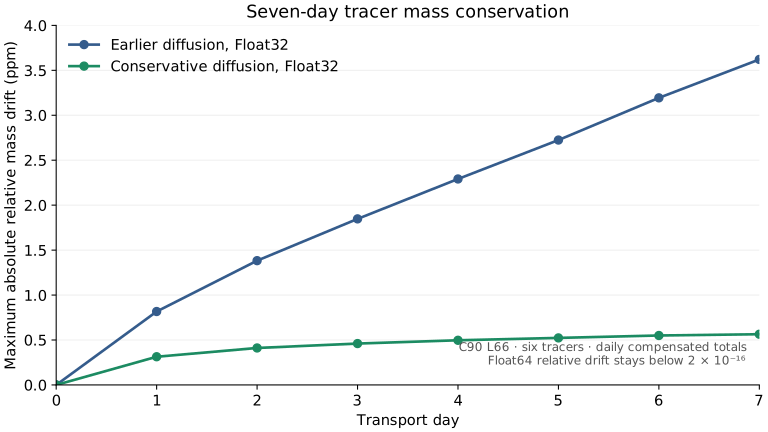
Across seven consecutive daily files with the same setup, worst final relative Float32 drift falls from 3.62e-6 with the earlier diffusion solve to 5.64e-7. All six final column-mean fields are closer to the Float64 reference, whose largest daily total drift is 1.98e-16. A 32-tracer week has the same maximum final Float32 drift.
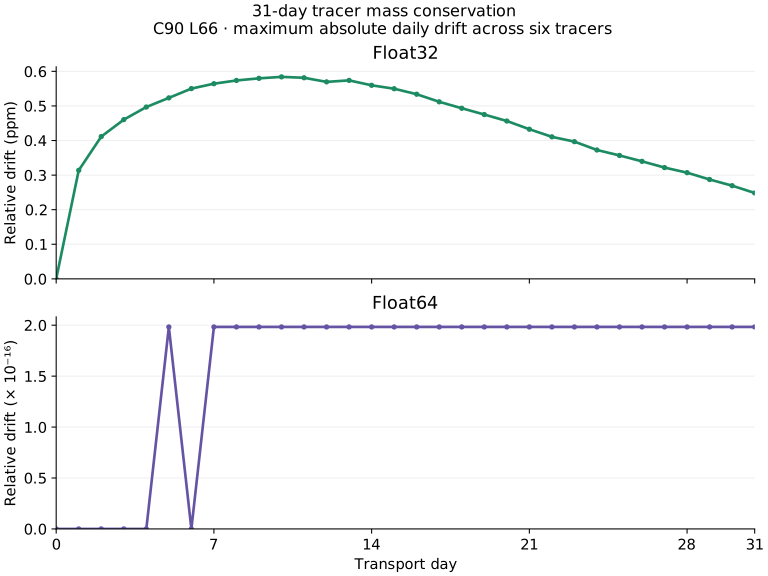
Extending the conservative setup through all 31 December inputs gives a maximum daily Float32 drift of 5.84e-7 on day 10 and a final drift of 2.48e-7. Float64 stays within 1.98e-16. All first-week total series match the earlier runs exactly. The declining Float32 endpoint reflects net error accumulation and cancellation; it does not replace the worst-daily measure. These daily samples cover one forcing sequence and do not bound within-day maxima, other archives, or longer durations.
The native final tracer-storage comparison across all panels and layers has maximum Float32-to-Float64 relative L2 difference 1.74e-6. Both precisions still produce small negative column means earlier in the month, about -1.46e-11 mol/mol. Conserved totals and finite output do not establish positivity or reference-model field accuracy.
Dry-basis vs moist-basis
The pipeline ships dry-basis by default (mass_basis = :dry in the binary header). The mathematical content of the conservation law is identical on either basis — what changes is the meaning of the stored m:
mass_basis | m represents | Tracer VMR semantics |
|---|---|---|
:dry | m_dry = m_moist · (1 − qv) per cell | dry VMR (χ_dry = μ / m_dry) |
:moist | total air mass per cell | moist VMR (χ_moist = μ / m_moist) |
Conversions happen at the boundaries:
Preprocessing.
apply_dry_basis_native!insrc/Preprocessing/mass_support.jlmultiplies cell-centeredm, dp, psand face-averagedam, bmby(1 − qv_face)with the appropriate face-averaging convention. After this step every payload field in the binary is dry.Runtime.
state.air_masscarries dry mass. Tracer storage instate.tracers_rawis mass, not VMR; the dry-VMR contract is enforced at the IC boundary (uniform-value initial conditions interpret4.0e-4as dry VMR and convert to mass viaχ × m_dryat construction) and at the snapshot-output boundary (<tracer>_column_mean = column-integrated tracer mass / column-integrated air massis dry by construction).Convection forcing. The CMFMC and DTRAIN fields shipped by GMAO are moist-basis. The GEOS reader's
_moist_to_dry_cmfmc!/_moist_to_dry_dtrain!apply the(1 − qv_face)correction so the convection operator consumes forcing on the same basis asstate.air_mass.
Mixing a moist binary with a dry-basis runtime is rejected at DrivenSimulation construction time — not at raw binary open, but well before any windows actually step.
Where the math meets the code
| Concept | File |
|---|---|
| X-sweep kernel (flux-form telescoping) | src/Operators/Advection/structured_kernels.jl |
| Strang palindrome (X→Y→Z / V/S/V / Z→Y→X) | src/Operators/Advection/StrangSplitting.jl (strang_split!) and CubedSphereStrang.jl (strang_split_cs!) |
Diagnose cm from dm target (LL / RG) | src/MetDrivers/ReplayContinuity.jl::recompute_cm_from_dm_target! |
Diagnose cm from dm target (CS) | src/Preprocessing/cs_poisson_balance.jl::diagnose_cs_cm! |
| Column balance against next-hour endpoint (GEOS-CS) | src/Preprocessing/cs_poisson_balance.jl::balance_cs_column_mass_fluxes! |
| Write-time replay gate | src/MetDrivers/ReplayContinuity.jl::verify_window_continuity_*! |
replay_tolerance(FT) | src/MetDrivers/ReplayContinuity.jl |
| Substep positivity gates | src/Preprocessing/transport_binary/{cubed_sphere_contracts.jl, latlon_contracts.jl, reduced_gaussian_contracts.jl} |
| Dry-basis correction | src/Preprocessing/mass_support.jl::apply_dry_basis_native! |
| Basis-mismatch enforcement | src/Models/DrivenSimulation.jl (construction) |
What's next
Advection schemes — per-scheme order, monotonicity, CFL.
Conservation budgets — what the test suite actually asserts.
Validation status — what's been validated against external reference data; what hasn't.