
Mass conservation
This page derives the discrete conservation contract that holds end-to-end across the AtmosTransport pipeline (preprocessor → binary → runtime → snapshot output) and quantifies the floating-point tolerances at which it holds.
The contract
For every cell c and every CFL-safe advection sub-step:
where F^n_f is the per-substep mass-amount through face f (units: kg per substep, the binary's flux_kind = :substep_mass_amount) and σ_{c,f} ∈ {+1, -1} is the inflow / outflow sign convention for face f at cell c. The same identity holds for every tracer mass μ^n_{c, t}:
with Φ^n_{f, t} the tracer-mass flux through face f. Because m and the tracer-mass slice live on the same staggering and use the same F, Φ triple-pairing, the mixing ratio χ = μ / m of a passive tracer that starts uniform stays uniform exactly under advection — modulo floating-point.
Telescoping divergence — why advection conserves total mass
For a closed periodic domain (lat-lon with periodic longitude) summing the update over all cells gives:
Each interior face appears in the sum twice — once with +F (the cell on the inflow side) and once with −F (the cell on the outflow side) — so the double-sum collapses to boundary fluxes only:
For a closed sphere there is no boundary, so the right-hand side identically vanishes mathematically — and to floating-point in the implementation, provided both cells use the same face flux at the same update stage. Writing each panel's update in flux form is insufficient if neighboring panels reconstruct different tracer fluxes. The structured X / Y / Z kernels in src/Operators/Advection/Structured/multitracer_kernels.jl use shared face values. The telescoping argument does NOT hold for schemes written in advective form (e.g. χ ∂_t = -u ∂_x χ), which is why every advection scheme in this repository is flux-form.
The same telescoping argument extends to:
Cubed-sphere Lin–Rood via shared final panel-edge tracer fluxes (
src/Operators/Advection/LinRoodSeams.jl) and mirrored air-mass fluxes. The q-space Lin–Rood path requires CFL-safe inputs: its existing cell-local emergency flux scaling breaks conservation when activated.Cubed-sphere Upwind, Slopes, and PPM via one cached physical seam transfer applied to both neighbors in the same directional group (
src/Operators/Advection/CubedSphere/CubedSphereSeams.jl). This also pairs rotated X/Y contacts. Halo exchange alone is insufficient; see Panel-edge halo treatment (cubed sphere).The reduced-Gaussian grid via the LCM-based ring-boundary face segmentation in
_boundary_counts(nlon_per_ring)insrc/Grids/ReducedGaussianMesh.jl. Each ring-pair boundary is split intolcm(nlon[j], nlon[j+1])segments so the outflow from ringjexactly equals the inflow to ringj+1.
Vertical closure
The discrete continuity equation for the vertical mass flux cm is:
with the surface boundary cm at k = N_z + 1 pinned to zero (no mass flux through the ground). All three production preprocessing paths produce cm via the same diagnostic:
LL spectral preprocessor. Runs the column FFT Poisson balance over the periodic-longitude grid (
balance_column_mass_fluxes!), then callsrecompute_cm_from_dm_target!to diagnosecmfrom the explicit(am, bm, dm)field.RG spectral preprocessor. Runs the column Poisson balance on the compressed ring Laplacian (
balance_compressed_column_fluxes!), then calls the samerecompute_cm_from_dm_target!diagnostic.GEOS native CS preprocessor. Column-balances horizontal mass fluxes against the raw next-hour dry endpoint (
balance_cs_column_mass_fluxes!), then callsdiagnose_cs_cm!(the cubed-sphere analogue ofrecompute_cm_from_dm_target!).
In every case the binary lands with a cm field that closes the explicit-dm continuity equation to floating-point tolerance — the write-time replay gate then verifies it before the binary file is committed to disk.
The production GEOS-CS path does not use the separate FV3-style pressure-fixer cm diagnostic; it closes against the raw dry endpoint described above.
Dry-mass pin and the column global mode
The humidity-aware spectral pin adds one uniform surface-pressure offset,
Native-layer dry-pressure and sensitivity sums and all three global reductions use compensated Float64 summation. The small target-minus-current numerator retains the compensated low parts and uses a fused multiply-add for the target pressure times area. The pin uses local scalar accumulators, without scratch allocations or shared mutable state.
Horizontal faces conserve global mass and cannot remove a remaining global endpoint mismatch. Let the column residual be convergence minus endpoint mass tendency, R_c, with arithmetic mean R̄, and let q_c = M_c / mean(M) for current column mass M_c = Σ_k m_{c,k}. For a fixed global dry-mass target, the column Poisson solve uses the shifted tendency T_c + R̄(q_c - 1) and accurately projects its right-hand side to zero mean. This is equivalent to distributing the shift across levels with fractions m_{c,k}/M_c. It leaves R̄ q_c, rather than a constant kilogram residual in every cell. Small polar cell budgets therefore do not amplify the global mode. Vertical closure still uses the original endpoint tendency and the configured layer weights. Raw residuals and the global mean remain diagnostic quantities.
Before applying this shift, a separate compensated global-budget guard requires
The expected global change is zero when the dry-mass pin is enabled. LL uses the equivalent numerator |2 n Σ dm| from its per-application tendency, with the actual window substep count n; RG and CS sum endpoint differences. The tolerance allows roughly two orders of magnitude above the measured post-pin Float64 roundoff of about 1e-16 relative per window (largest measured changes: 666.004 and 659.033 kg out of about 5.1e18 kg). Lower-precision stored endpoints allow the larger of this tolerance and 2 eps(FT), a bound for rounding both endpoints. Reductions use the stored values in Float64. The guard runs regardless of whether replay is enabled and uses no flux scale; circulation and substep refinement cannot dilute a global-budget error. A polar regression with m_next = m*(1+1e-10), 100 substeps and divergence-free zonal flux am = 0.25m per application is rejected; an O(eps(Float64)) mismatch passes. Replay alone can accept the former case because its denominator grows with circulation.
For moist-basis or unpinned windows, a physical global mass change is permitted. These paths neither assert a zero global budget nor apply the mass-proportional shift. They retain the uniform nullspace treatment, original endpoint tendency, and the existing local replay and CS closure checks. Conservative horizontal faces cannot close a genuine global source or sink: it must be represented by a physical boundary/source term or remain in the raw residual. Local checks can reject an incompatible budget, but are not an independent global guarantee.
This treatment applies to LL FFT, RG PCG/direct and CS column solves. The spectral pin applies to point-sampled LL/RG/CS and TM5 LL/RG construction. The same CS column balance is used by spectral CS, LL-binary-to-CS regridding, ERA5 N320 regridding, MERRA-2 and the GEOS endpoint-balanced, moisture-filtered and OMEGA closures. Native sources retain their separate mass-pin routine. The separately callable CS per-level balance retains its original target and arithmetic. The TM5 LL and RG layer solves also retain their original arithmetic: compensated projections are selected by separate dispatch only for column solves.
The production call sites are:
| Routine | Callers and coverage |
|---|---|
pin_global_mean_ps_using_qv! | construct_tm5_endpoint (TM5 LL/RG), apply_mass_fix_if_needed! (point-sampled LL and spectral CS staging), pin_convert_merge_window! (point-sampled RG) |
balance_column_mass_fluxes! | apply_poisson_balance! (point-sampled and TM5 LL) |
balance_compressed_column_fluxes! | RG balance_window! (point-sampled), RG process_day for TM5SpectralFluxes (direct solver) |
balance_cs_column_mass_fluxes! | cs_spectral_contract_diag!, regrid_ll_binary_to_cs, process_era5_n320_to_cs_day, MERRA-2 _balance_window!, and GEOS _geos_prepare_window_for_steps! (moisture-filtered, both OMEGA modes and endpoint-balanced branches) |
balance_cs_global_mass_fluxes! | balance_cs_column_mass_fluxes! on single-level column buffers, with mass weighting only for fixed dry targets; standalone per-level callers retain original target and projection arithmetic |
balance_mass_fluxes! | TM5 LL balance_tm5_layers! uses the original FFT RHS; column calls explicitly select compensated RHS projection |
project_mean_zero! | TM5 RG balance_compressed_level! → solve_compressed_poisson_direct!, standalone RG/CS solvers: original sum(v)/length(v); column solvers explicitly select compensated dispatch |
check_fixed_global_mass | LL/RG/CS column entry points only when dry mass is pinned; spectral settings, native pin flags, or a dry regrid source's recorded pin enable it |
Measured 1° dry-mass and replay correction
CPU validation uses ERA5 2021-12-01 on 360 × 180 cells, Float64 dry mass, 34 ml137_tropo34a levels, and all 24 windows (52,876,800 budgets per construction). The point-sampled construction retains its default T179 truncation; TM5 retains T639. The after runs use the stock 1e-12 replay gate and adaptive positivity checks. TM5 was regenerated through the binary writer; point-sampled endpoints use the bounded hourly diagnostic driver with the production pin, dry conversion, merge, balance and closure.
| Construction | median | p99 | p99.99 | maximum | count > 1e-12 |
|---|---|---|---|---|---|
| TM5 before | 2.0295e-15 | 5.1465e-14 | 5.6883e-13 | 1.4709e-12 | 536 |
| TM5 after | 0.0000e+00 | 2.0675e-16 | 1.1806e-15 | 5.8233e-15 | 0 |
| Point-sampled before | 1.4122e-15 | 3.4638e-14 | 2.8047e-13 | 1.0639e-12 | 6 |
| Point-sampled after | 0.0000e+00 | 2.0077e-16 | 8.5414e-16 | 6.1071e-15 | 0 |
Largest absolute global mass change per window falls from 135,695.388 to 666.004 kg for TM5 and from 121,982.453 to 659.033 kg for point-sampled construction. The remaining mass changes and endpoint target errors are reported separately from the local replay metric; they cannot be removed by conservative horizontal faces. Maximum relative endpoint target errors after the change are 6.651e-17 (TM5) and 7.338e-17 (point-sampled), measured with compensated mass totals against the dry-pressure area integral.
All spectral pre_* golden outputs are expected to change at rounding level. The same column-mode treatment also applies to native-source and regrid callers; it does not change the separate native mass-pin routine or the Float64 1e-12 / Float32 1e-5 replay thresholds.
Replay-gate tolerance
Conservation in floating-point is verified per window and per cell. With n substeps per window, the stored per-substep face fluxes F of cell c must carry its mass from one window to the next:
The right-hand side is the sum of the magnitudes of the budget's terms, which bounds the rounding error of evaluating the sum (Higham, Accuracy and Stability of Numerical Algorithms, 2nd ed., SIAM 2002, ch. 4). Measuring each cell against its own budget keeps the test as strict in the thin top layers as in thick boundary-layer cells; a test normalised by the largest cell mass would be 10⁴–10⁵ times looser there.
replay_tolerance(FT) (src/MetDrivers/ReplayContinuity.jl) returns the constants of src/Parameters/NumericalDefaults.jl:
| FT | τ(FT) | worst current binary |
|---|---|---|
Float64 | 1e-12 | 6.5e-14 |
Float32 | 1e-5 | 1.0e-6 |
Float64 binaries are limited by the residual of the Poisson flux balance; Float32 binaries by Float32 rounding (about 9 eps(Float32)). The measured values cover the 2026-10 golden binaries and samples of the C90 ERA5, MERRA-2 and C180 GEOS-IT production binaries. A binary loaded in a different float type than it is stored in is checked at the tolerance of the less precise type.
These replay gates check carrier-air continuity. They do not bound tracer drift or establish consistency of reconstructed tracer fluxes at panel seams; tracer conservation needs its own tests. Because cm is diagnosed from the same horizontal fluxes just before the check, the gate certifies that the stored payload is self-consistent, not that the winds are right: see What the replay gate certifies.
The gate fires twice in the lifecycle of a binary:
Write-time (on by default, in the preprocessor). A binary that fails is rejected at write time — the preprocessor errors out rather than producing a known-bad file.
[numerics] write_replay_check = falseis an explicit diagnostic escape hatch; do not use it for production binaries. A binary written that way recordswrite_replay_check = falsein its header.Load-time (opt-in, in the runtime). Set
[input] validate_replay = true(thevalidate_replaykeyword ofTransportBinaryDriver). Off by default because it doubles binary load time; recommended for any new binary configuration before a long production simulation.
Implicit diffusion and roundoff
The precomputed cubed-sphere Dkg path solves backward Euler directly for tracer mass. For exchange rate D[k] between layers k and k+1, define u[k] = dt*D[k]/m[k] and d[k] = dt*D[k]/m[k+1]. The mass-space matrix has diagonal 1 + u[k] + d[k-1], lower diagonal -u[k-1], and upper diagonal -d[k]. Its columns sum to one: a closed diffusion column conserves mass.
Ordinary Float32 Thomas elimination in VMR space can lose that cancellation through coefficient rounding and mass/VMR conversion. The state-mass entry point instead uses two column-conservative bidiagonal factors. Their inverses are directed retention/transfer passes. Starting with v[0] = 0, their ratios are
The downward pass retains fraction 1/(1+r[k]); the upward pass retains 1/(1+v[k-1]). Each passes the complementary mass to the adjacent layer. This is a factorization of the same backward-Euler equation, not a correction or rescaling of the tracer total. Factors are shared across all tracers.
The implementation computes the smaller partition directly, because subtracting a rounded retention from one can erase a weak exchange into an empty layer. Compensated incoming sums reduce loss of small layer contributions in stiff columns. A removable constant background is chosen from the concentration range's endpoint closest to zero; profiles spanning zero use zero. Layers with no exchange retain their input values exactly. These operations need no additional persistent workspace and use Float32 arithmetic on Float32 states.
The adjoint reverses the two passes with the same ratios. Tests cover signed and positive tracers, weak transfers down to dt*D/m = 1e-14, stiff columns, zero exchange, and constant total-mass gradients.
Kz diffusion fields (the lat-lon and reduced-Gaussian runs, and local-Kz cubed-sphere runs) keep the Thomas solve, but only for the new mixing ratio g. The tracer mass is then updated in flux form: each interface flux F[k] = dt*D[k]*(g[k] - g[k+1]) is computed once and applied with opposite signs to layers k and k+1, so the column total telescopes. Writing back m[k]*g[k] instead lost mass with one sign in Float32, because the rounding of the diagonal 1 + u[k] + d[k-1] is the same in every column of the pure-pressure levels (2.0e-6 of a tracer per day in a lat-lon L72 run). The remaining rounding goes through the same column ledger with persistent carry as the Dkg solve (Tracer Conservation in Single Precision). The VMR-level reference solve keeps the matrix form. The conservation statement assumes positive carrier masses and closed column boundaries; the existing zero-carrier sink convention is preserved separately. Floating-point storage still introduces roundoff, so conservation of the mathematical operator is not a promise of identical stored totals in every run.
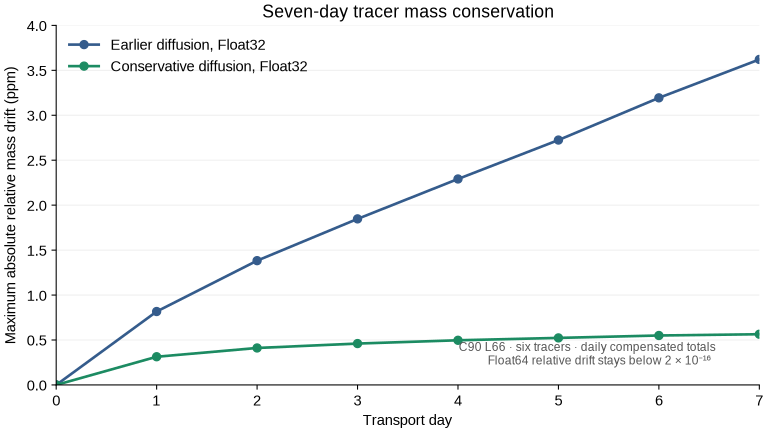
On one C90 L66, 24-hour V100 PPM workload after paired advection seams, this diffusion path reduces the maximum final Float32 relative tracer-total drift from 8.17e-7 to 3.14e-7. All six final Float64 compensated totals match initialization; their maximum hourly relative drift is 1.98e-16. The exploratory Float32 target 1e-7 is not met. All six final Float32 column-mean fields are closer to the Float64 result. The initial conservative solve costs 38.635 s median for the 32-tracer day; distributing CUDA tracer solves across threads reduces this to 29.543 s with identical output and no new persistent workspace. The earlier VMR solve with paired advection seams takes 34.574 s.
Across seven consecutive daily files with the same setup, worst final relative Float32 drift falls from 3.62e-6 with the earlier diffusion solve to 5.64e-7. All six final column-mean fields are closer to the Float64 reference, whose largest daily total drift is 1.98e-16. A 32-tracer week has the same maximum final Float32 drift.
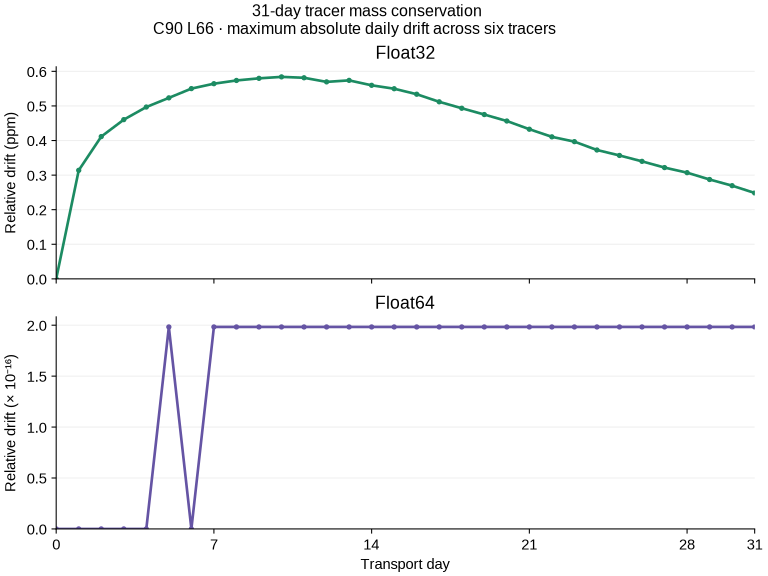
Extending the conservative setup through all 31 December inputs gives a maximum daily Float32 drift of 5.84e-7 on day 10 and a final drift of 2.48e-7. Float64 stays within 1.98e-16. All first-week total series match the earlier runs exactly. The declining Float32 endpoint reflects net error accumulation and cancellation; it does not replace the worst-daily measure. These daily samples cover one forcing sequence and do not bound within-day maxima, other archives, or longer durations.
The native final tracer-storage comparison across all panels and layers has maximum Float32-to-Float64 relative L2 difference 1.74e-6. Both precisions still produce small negative column means earlier in the month, about -1.46e-11 mol/mol. Conserved totals and finite output do not establish positivity or reference-model field accuracy.
Dry-basis vs moist-basis
The pipeline ships dry-basis by default (mass_basis = :dry in the binary header). The mathematical content of the conservation law is identical on either basis — what changes is the meaning of the stored m:
mass_basis | m represents | Tracer VMR semantics |
|---|---|---|
:dry | m_dry = m_moist · (1 − qv) per cell | dry VMR (χ_dry = μ / m_dry) |
:moist | total air mass per cell | moist VMR (χ_moist = μ / m_moist) |
Conversions happen at the boundaries:
Preprocessing.
apply_dry_basis_native!insrc/Preprocessing/Spectral/mass_support.jlmultiplies cell-centeredm, dp, psand face-averagedam, bmby(1 − qv_face)with the appropriate face-averaging convention. After this step every payload field in the binary is dry.Runtime.
state.air_masscarries dry mass. Tracer storage instate.tracers_rawis mass, not VMR; the dry-VMR contract is enforced at the IC boundary (uniform-value initial conditions interpret4.0e-4as dry VMR and convert to mass viaχ × m_dryat construction) and at the snapshot-output boundary (<tracer>_column_mean = column-integrated tracer mass / column-integrated air massis dry by construction).Convection forcing. The CMFMC and DTRAIN fields shipped by GMAO are moist-basis. The GEOS reader's
moist_to_dry_cmfmc!/moist_to_dry_dtrain!apply the(1 − qv_face)correction so the convection operator consumes forcing on the same basis asstate.air_mass.
Mixing a moist binary with a dry-basis runtime is rejected at DrivenSimulation construction time — not at raw binary open, but well before any windows actually step.
Where the math meets the code
| Concept | File |
|---|---|
| X-sweep kernel (flux-form telescoping) | src/Operators/Advection/Structured/multitracer_kernels.jl |
| Strang palindrome (X→Y→Z / V/S/V / Z→Y→X) | src/Operators/Advection/Structured/StrangSplitting.jl (strang_split!) and CubedSphereStrang.jl (strang_split_cs_mt!) |
Diagnose cm from dm target (LL / RG) | src/MetDrivers/ReplayContinuity.jl::recompute_cm_from_dm_target! |
Diagnose cm from dm target (CS) | src/Preprocessing/MassClosure/cs_poisson_balance.jl::diagnose_cs_cm! |
| Column balance against next-hour endpoint (GEOS-CS) | src/Preprocessing/MassClosure/cs_poisson_balance.jl::balance_cs_column_mass_fluxes! |
| Write-time replay gate | src/MetDrivers/ReplayContinuity.jl::verify_window_continuity_*! |
replay_tolerance(FT) | src/MetDrivers/ReplayContinuity.jl |
| Substep positivity gates | src/Preprocessing/Targets/{CubedSphere,LatLon,ReducedGaussian}/*_contracts.jl |
| Dry-basis correction | src/Preprocessing/Spectral/mass_support.jl::apply_dry_basis_native! |
| Basis-mismatch enforcement | src/Models/Runner/DrivenSimulation.jl (construction) |
What's next
Advection schemes — per-scheme order, monotonicity, CFL.
Conservation budgets — what the test suite actually asserts.
Validation status — what's been validated against external reference data; what hasn't.