
Grids
AtmosTransport supports three horizontal grid topologies, all sharing the same hybrid-σ-pressure vertical coordinate. From a user's perspective, the grid is fixed by the transport binary (the preprocessor produces one binary per grid configuration); the runtime reads the binary's header and dispatches automatically. You usually do not need to declare the grid in a run config — only in a preprocessing config.
Topology overview
| Topology | Concrete mesh type | Index space | Typical use |
|---|---|---|---|
| Regular lat-lon | LatLonMesh{FT} | (i, j) ∈ (1..Nx, 1..Ny) | ERA5 spectral preprocess; coarse / mid-resolution comparison runs. |
| Reduced Gaussian | ReducedGaussianMesh{FT} | (c) ∈ (1..ncells), with nlon_per_ring[j] cells in latitude ring j | ERA5 native grid (e.g. O90, O160, N320); finer at the equator without polar over-sampling. |
| Cubed-sphere | CubedSphereMesh{FT, C, D} | (p, i, j) per panel p ∈ 1..6, cell (i, j) ∈ (1..Nc, 1..Nc) | Synthetic equiangular CS, GEOS-IT C180, GEOS-FP C720. |
All three subtype AbstractHorizontalMesh and are wrapped in AtmosGrid{H, V, Arch, P, FT} together with a vertical coordinate (HybridSigmaPressure{FT}), an architecture (CPU / GPU), and a planet (PlanetParameters{FT}, defaulting to earth_parameters() — Earth radius, gravity, reference pressure).
What you specify vs what is inferred
The transport binary's JSON header carries enough geometry to reconstruct the grid at runtime, so a run config does not need a [grid] block:
# config/runs/quickstart/ll72x37_advonly.toml
[input]
folder     = "~/data/.../era5_ll72x37_dec2021_f32/"
start_date = "2021-12-01"
end_date   = "2021-12-03"
# (no [grid] block needed — read from the binary header)
The runtime calls inspect_binary on the first file, reads the grid_type field (:latlon | :reduced_gaussian | :cubed_sphere), and constructs the correct mesh + driver.
Legacy run configs
Some older config/runs/*.toml files still carry a [grid] block. The current runner ignores it for grid construction (the binary header wins), but be aware when reading examples — newer configs in config/runs/quickstart/ and config/runs/advresln/ follow the no-[grid] pattern.
A preprocessing config is where you declare the target grid, since that's the act of choosing one:
# config/preprocessing/era5_ll72x37_advresln_dec2021_f32.toml
[grid]
type = "latlon"
nlon = 72
nlat = 37
echlevs = "ml137_tropo34"# config/preprocessing/era5_cs_c90_transport_binary_f32.toml
[grid]
type = "cubed_sphere"
Nc = 90
echlevs = "ml137_tropo34"# config/preprocessing/era5_o090_transport_binary.toml
[grid]
type = "synthetic_reduced_gaussian"
gaussian_number = 90 # ring count per hemisphere → O90
nlon_mode = "octahedral" # ECMWF O-grid (octahedral) ring distributionLatLonMesh{FT} {#LatLonMesh{FT}}
A regular Nx × Ny lat-lon mesh with periodic longitude and pole truncation. Constructor:
mesh = LatLonMesh(; Nx, Ny,
                    longitude = (-180, 180),
                    latitude  = (-90, 90),
                    radius    = R_EARTH)
User-touched fields: Nx, Ny, Δλ, Δφ, λᶜ (cell-center longitudes), λᶠ (face longitudes), φᶜ, φᶠ, radius. Cell-area helpers: cell_area(mesh, i, j), cell_areas_by_latitude(mesh).
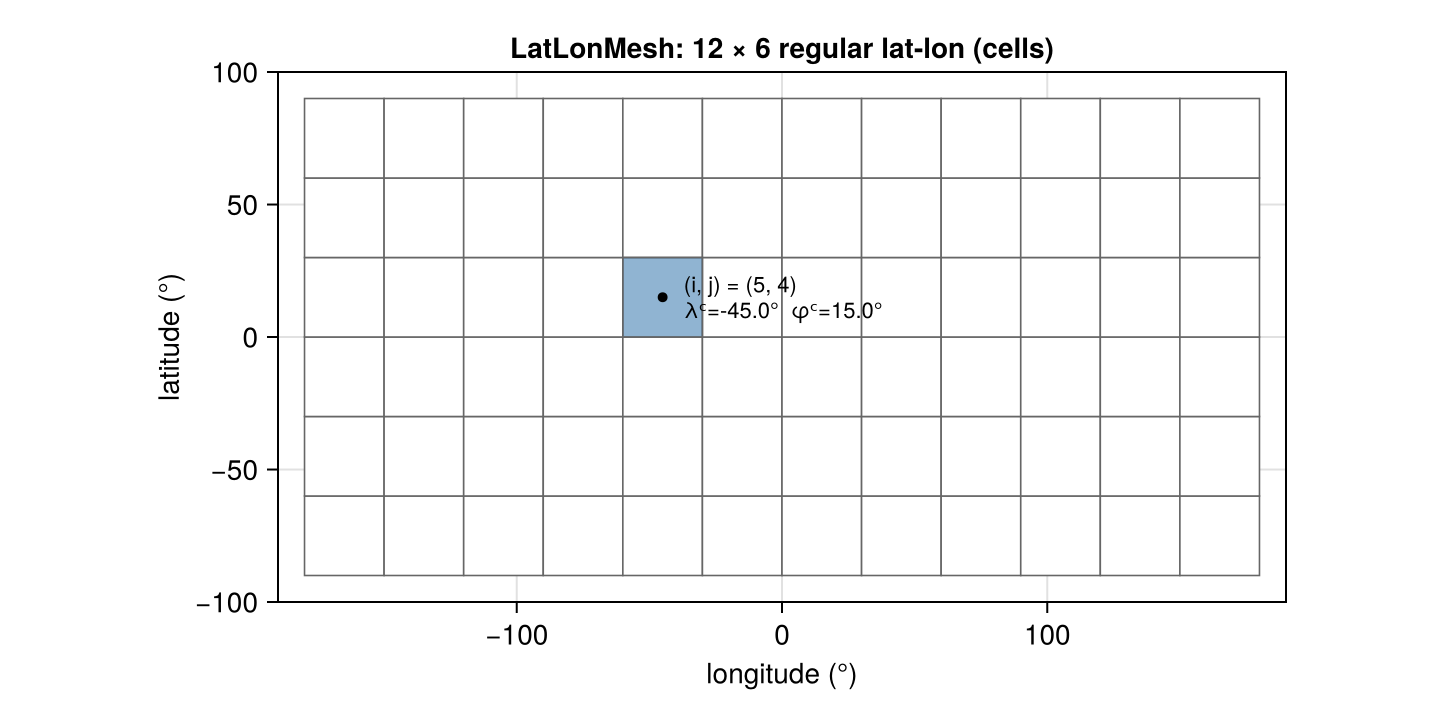
The face arrays follow the λᶜ[1]-aligned convention — used by the spectral preprocessor's spectral_to_grid! to set lon_shift_rad = deg2rad(λᶜ[1]). Mismatching this shift was a real bug; the API codifies the convention so users don't trip on it.
ReducedGaussianMesh{FT} {#ReducedGaussianMesh{FT}}
A reduced-Gaussian grid is a sphere of latitude rings with a variable number of cells per ring (more cells near the equator, fewer near the poles). Cells are flattened ring-by-ring, south to north.
Two construction paths:
# Direct: known ring latitudes + per-ring longitude counts.
mesh = ReducedGaussianMesh(latitudes, nlon_per_ring; FT = Float32)

# From an ECMWF GRIB descriptor (the preprocessor's usual entry point).
mesh = read_era5_reduced_gaussian_mesh(path_to_grib; FT = Float32)
User-touched fields: latitudes (ring centers), nlon_per_ring, ring_offsets (where each ring starts in the flat cell array), lat_faces, radius.
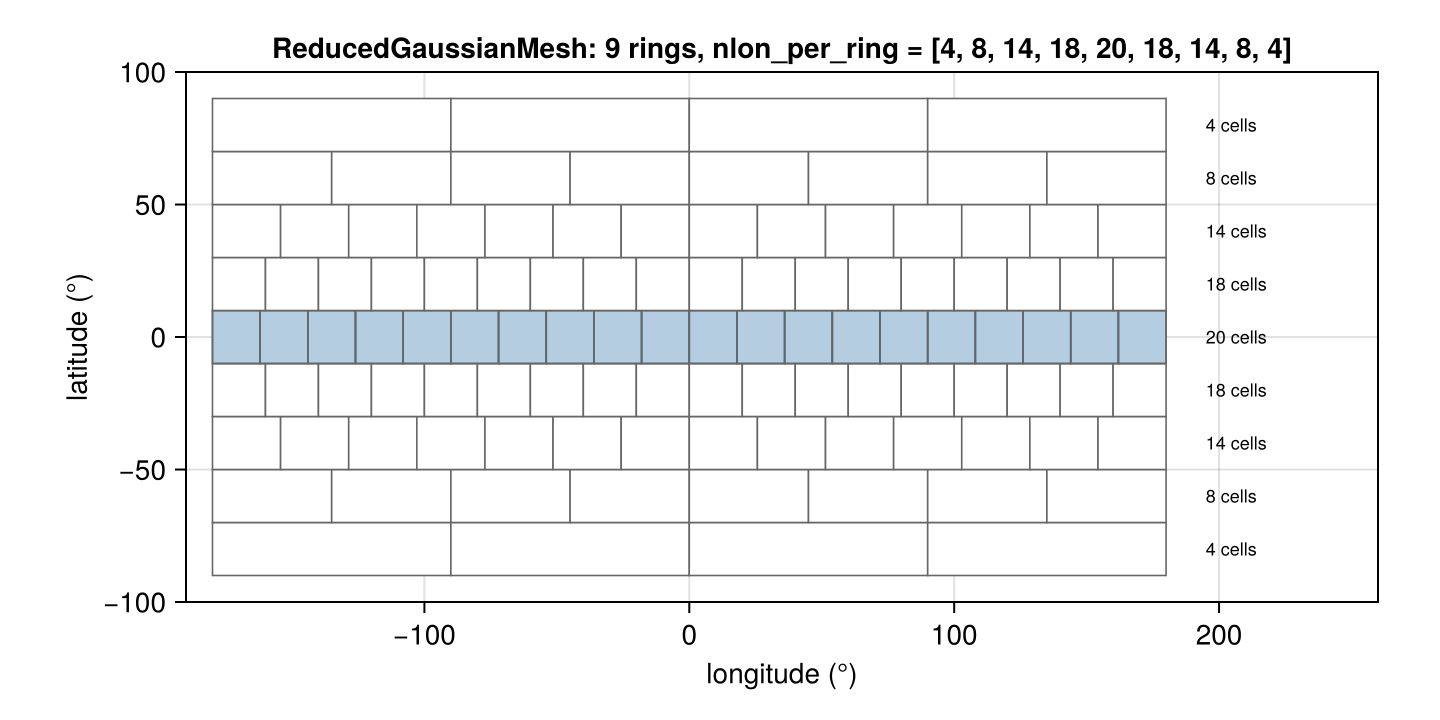
Per-ring meridional faces use a least-common-multiple segmentation between adjacent rings — necessary so flux conservation holds across ring boundaries with different nlon.
CubedSphereMesh{FT, C, D} {#CubedSphereMesh{FT,-C,-D}}
A six-panel cubed-sphere mesh of resolution Nc × Nc per panel. The mesh stores a full cubed-sphere definition rather than assuming that all CS grids are the same geometry. Constructor:
mesh = CubedSphereMesh(; Nc,
                        FT         = Float64,
                        radius     = R_EARTH,
                        convention = GnomonicPanelConvention(),
                        definition = nothing)

geos_it = GEOSIT_C180()
geos_fp = GEOSFP_C720()
User-touched fields: Nc (cells per panel edge), Hp (halo width), radius, definition, convention, connectivity, cell_areas, Δx, Δy.
Cubed-sphere definitions
The definition is the geometry contract:
| Component | Meaning | Main implementations |
|---|---|---|
| Coordinate law | Places logical face edges on the cube/gnomonic plane. | EquiangularGnomonic, GMAOEqualDistanceGnomonic |
| Center law | Computes (lon, lat) cell centers from the face geometry. | AngularMidpointCenter, FourCornerNormalizedCenter |
| Panel convention | Orders/orients the six panels in file/index space. | GnomonicPanelConvention, GEOSNativePanelConvention |
| Longitude offset | Final rigid rotation about the polar axis. | 0° for synthetic, -10° for GEOS |
EquiangularCubedSphereDefinition() is the legacy synthetic target. It uses
and evaluates centers at the logical midpoint (i+1/2, j+1/2).
GMAOCubedSphereDefinition() is the native GEOS target used by GEOS-IT C180 and GEOS-FP C720. It uses the GMAO equal-distance gnomonic edge law
Cell centers use the GEOS/FV cell_center2 rule:
where v₁..v₄ are the unit corner vectors of the cell. This is the rule that reproduces GEOS-IT C180, panel 1, cell (i=90, j=140) at lat = 26.468021° and the native 0.42°/0.55° meridional spacing pattern.
Panel conventions
Two panel orderings ship today:
| Convention | Panel layout |
|---|---|
GnomonicPanelConvention() | Panels 1–4 around the equator; panel 5 north pole; panel 6 south pole. |
GEOSNativePanelConvention() | GEOS-FP / GEOS-IT native ordering: panels 1–2 + 4–5 around the equator; panel 3 north; panel 6 south. |
The convention is only the panel file order/orientation. Native GEOS geometry also requires GMAOEqualDistanceGnomonic, FourCornerNormalizedCenter, and the -10° longitude offset; use GMAOCubedSphereDefinition() or the GEOSIT_C180() / GEOSFP_C720() constructors for those targets.
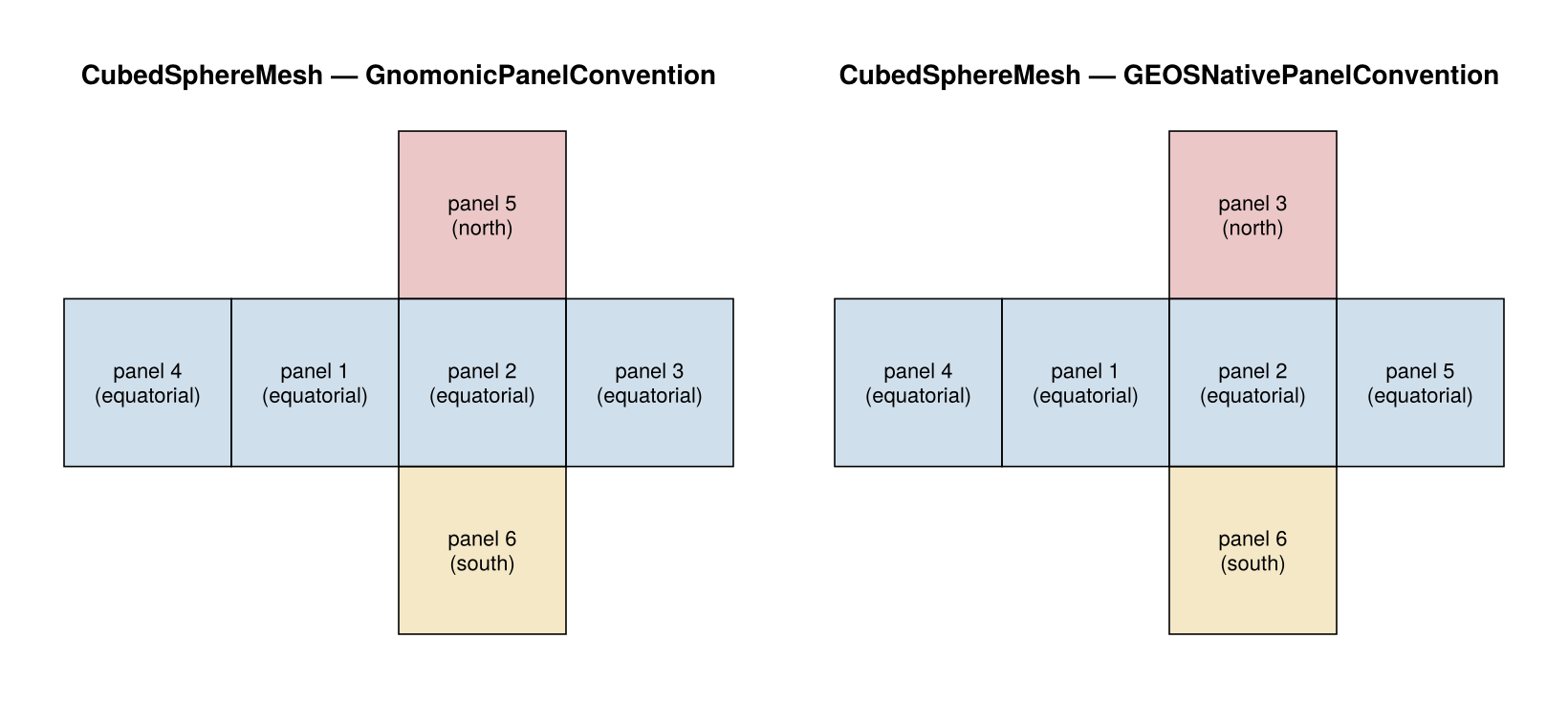
Pick whichever matches the data you are ingesting. The preprocessor writes the convention into the binary header; the runtime reads it back and constructs the right mesh + connectivity.
panel_convention(mesh) returns the convention struct; panel_connectivity_for(convention) returns the matching PanelConnectivity (panel-edge wiring used to rotate fluxes across panel boundaries).
Panel-cell helpers
| Helper | Returns |
|---|---|
panel_cell_center_lonlat(mesh, panel) | (lons, lats) matrices, each (Nc, Nc). |
panel_cell_corner_lonlat(mesh, panel) | The four corner lat/lons per cell. |
panel_cell_local_tangent_basis(mesh, panel) | (x_east, x_north, y_east, y_north) tangent-basis matrices in geographic frame. |
The tangent basis is what rotate_winds_to_panel_local! and rotate_panel_to_geographic! (in Preprocessing/cs_transport_helpers.jl) consume.
AtmosGrid{H, V, Arch, P, FT} {#AtmosGrid{H,-V,-Arch,-P,-FT}}
The composite grid type that the runtime carries:
AtmosGrid
├── horizontal :: AbstractHorizontalMesh   # one of the three above
├── vertical   :: HybridSigmaPressure{FT}  # ΔA / ΔB at interfaces
├── arch       :: CPU | GPU
└── planet     :: PlanetParameters{FT}      # earth_parameters() default
The user rarely constructs AtmosGrid directly; it is built by the runtime from the binary header in BinaryPathExpander.jl / DrivenRunner.jl.
Geometry helpers
The most useful per-topology helpers are:
| Mesh | Helper | Returns |
|---|---|---|
LatLonMesh | cell_area(mesh, i, j) | Area of cell (i, j) in m². |
LatLonMesh | cell_areas_by_latitude(mesh) | Per-latitude-band area distribution. |
ReducedGaussianMesh | cell_area(mesh, c) | Area of flat-indexed cell c in m². |
ReducedGaussianMesh | face_length(mesh, f) | Length of face f in m. |
CubedSphereMesh | mesh.cell_areas, mesh.Δx, mesh.Δy | Per-panel area and edge-length matrices. |
A unified cross-topology API for area / face length is on the roadmap but not yet implemented. Today, geometry-aware code dispatches on the mesh type and reaches into the appropriate per-topology helper.
What's next
State & basis — how prognostic state is laid out on a grid.
Operators and Binary format — covered in Phase 3B of the documentation overhaul; pages will land in a follow-up commit.